Zen-Core Editor-Librarian V.2.0 for Roland Fantom 6-7-8,
Fantom 6-7-8 EX, Fantom-06/07/08, AX-Edge, Jupiter-X/Xm synthesizers
with "B67 ZEN-FM" Synthesis Engine Editor
ZEN-Core Sound Banks - 3 collections - (419 tones) for all Roland Synthesizers, Piano, Groovebox, Wind-Instruments, Guitar Synth
compatible with the ZEN-Core standard The editors and sound collections are available individually or in bundles
It includes 112
tones created with 'B67 ZEN-FM'
synthesis. The sounds are distribuited
in two formats:
- Standard ZEN-Core format:
compatible with all synthesizers
- Proprietary editable format:
manageable via the dedicated B67 ZEN-FM
page in Editor/Librarian V. 2.0
SHOP
Editor Librarian Zen-Core
V. 2.0
Promo ZEN-Core Editor Librarian V 2.0 and B67 ZEN-Core Banks Collection
3
Video Guide
Compatibility
- Windows 10/11
- Mac CPU Intel x86-64 - Sierra (MacOS 10.12), High Sierra (MacOS 10.13), Mojave (MacOS 10.14), Catalina (MacOS 10.13), Big Sur (MacOS 11.x)
- Mac CPU Intel x64/ARM64: Big Sur (MacOS 11.x), Monterey (MacOS 12.x), Ventura (MacOS 13.x),
Sonoma (MacOS 14.x), Sequoia (MacOS 15.x)
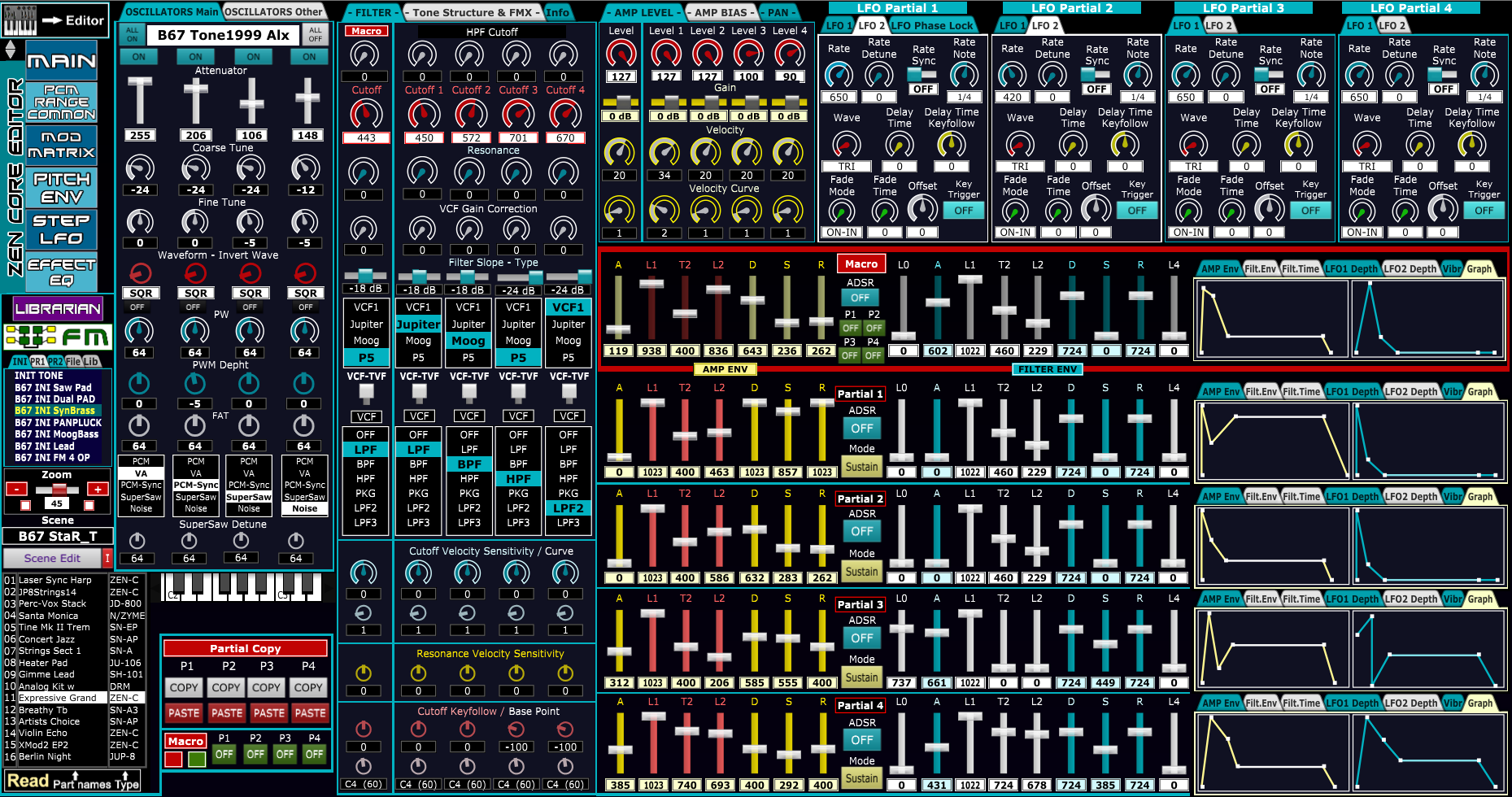
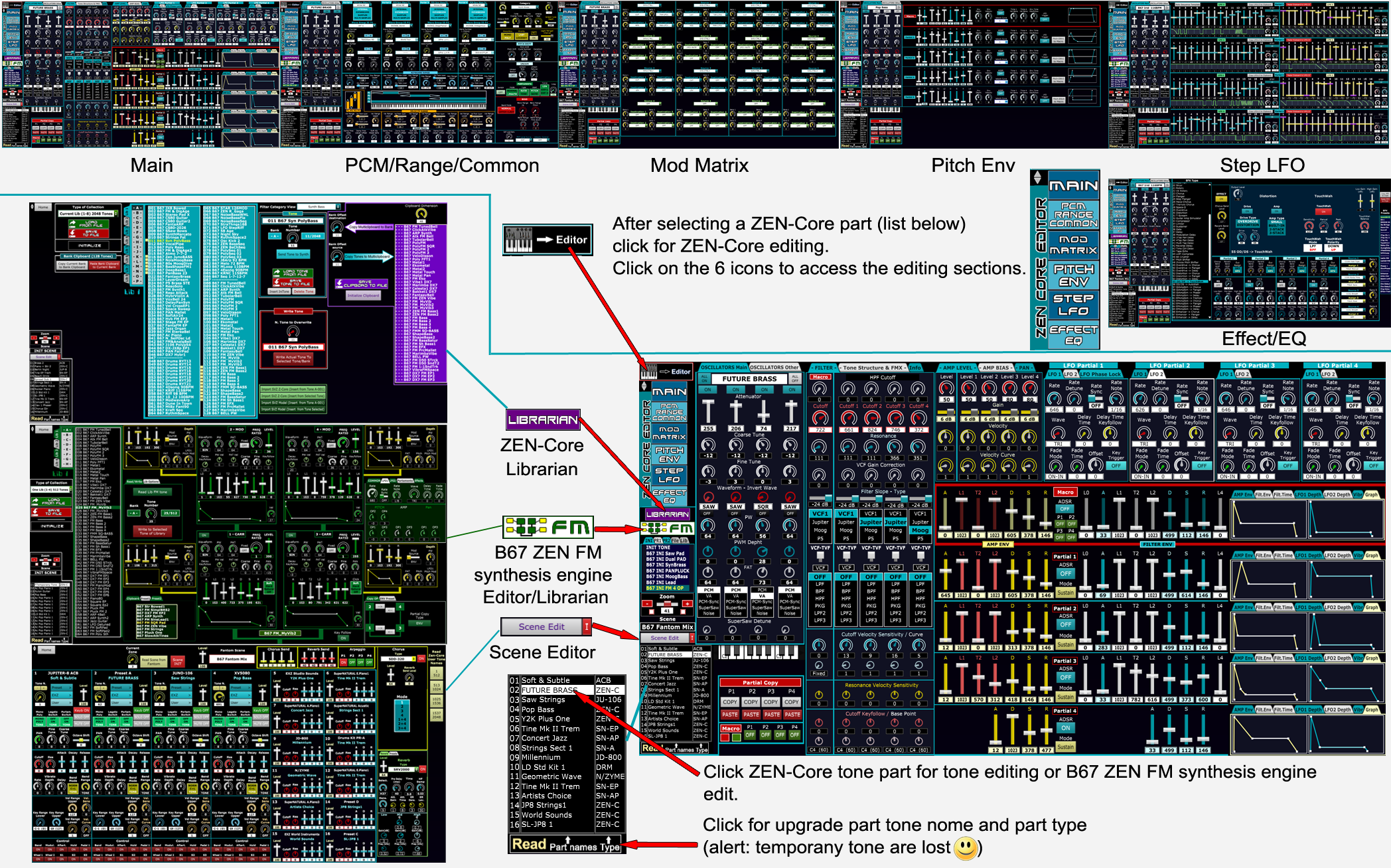
ZEN-Core editing section
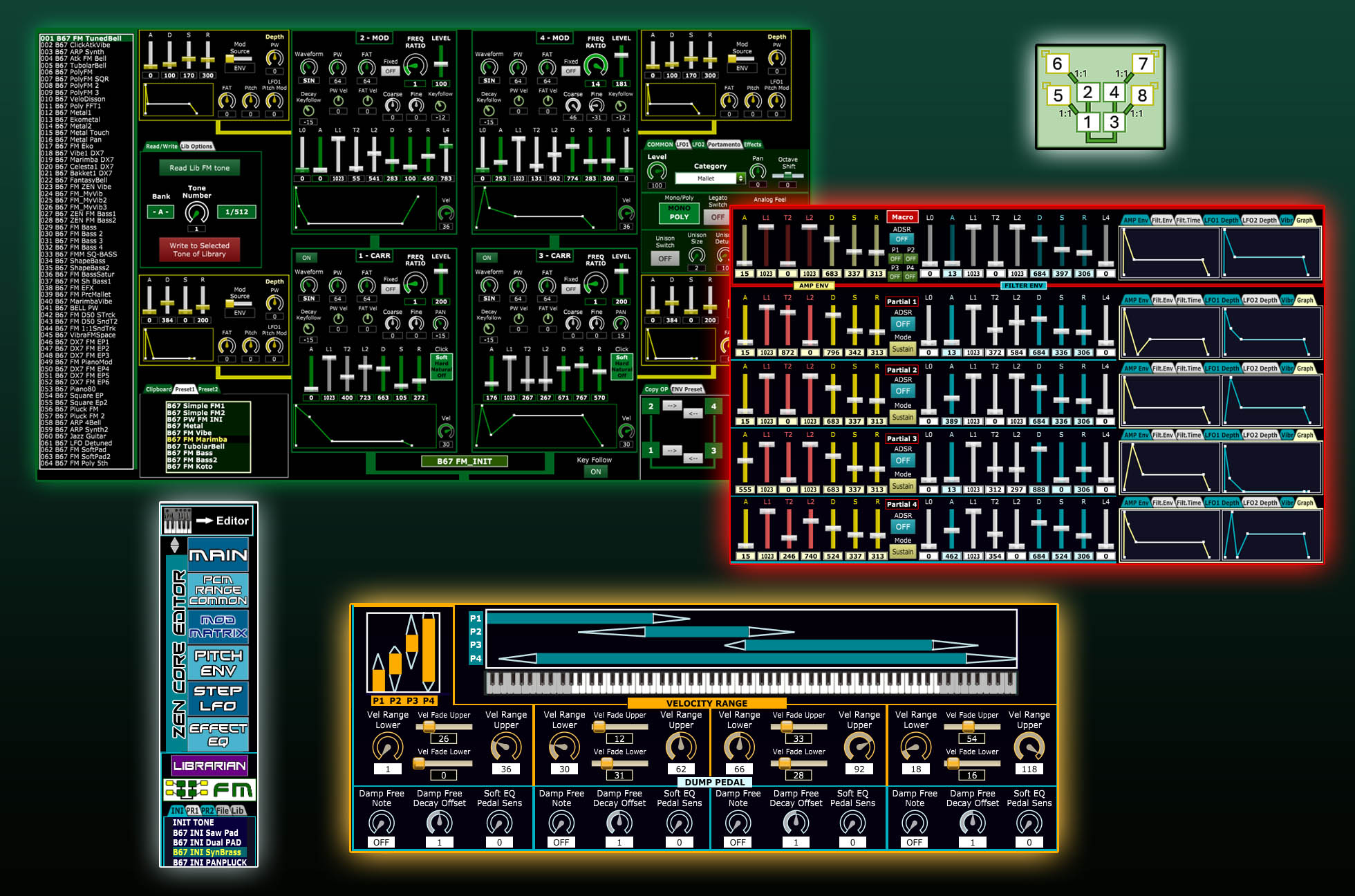
Editing of ZEN-Core tones structured in 6 subsections where you can modify
all the synthesis parameters and those relating to the 93 effects provided by
the standard. Below is a list of the main features.
- Vector and resizable graphic interface.
- Communication speed between synth and computer capable of real-time
listening of changes without any additional latency. The division of the summary
parameters allows the editing of the most important parameters in a single
screen.
- Real time graphic display of the envelopes (Filter, AMP and Pitch) and the
keyboard and velocity range sections
- Copy and paste of partials via
clipboard.
- Use of Macro controls to speed up editing by controlling the
same parameter of any combination of the 4 partials in parallel.
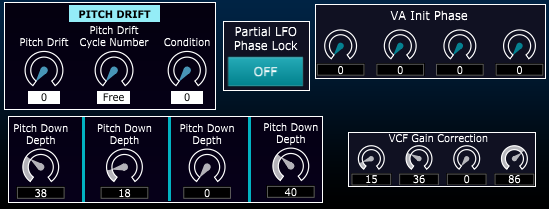
- Editing of "hidden" ZEN-Core synthesis parameters not directly
accessible in the synths: VCF Gain Correction,
Partial LFO Phase Lock, Pitch Down Depth, Pitch Drift, Pitch Drift Cycle Number - Condition e VA Init Phase
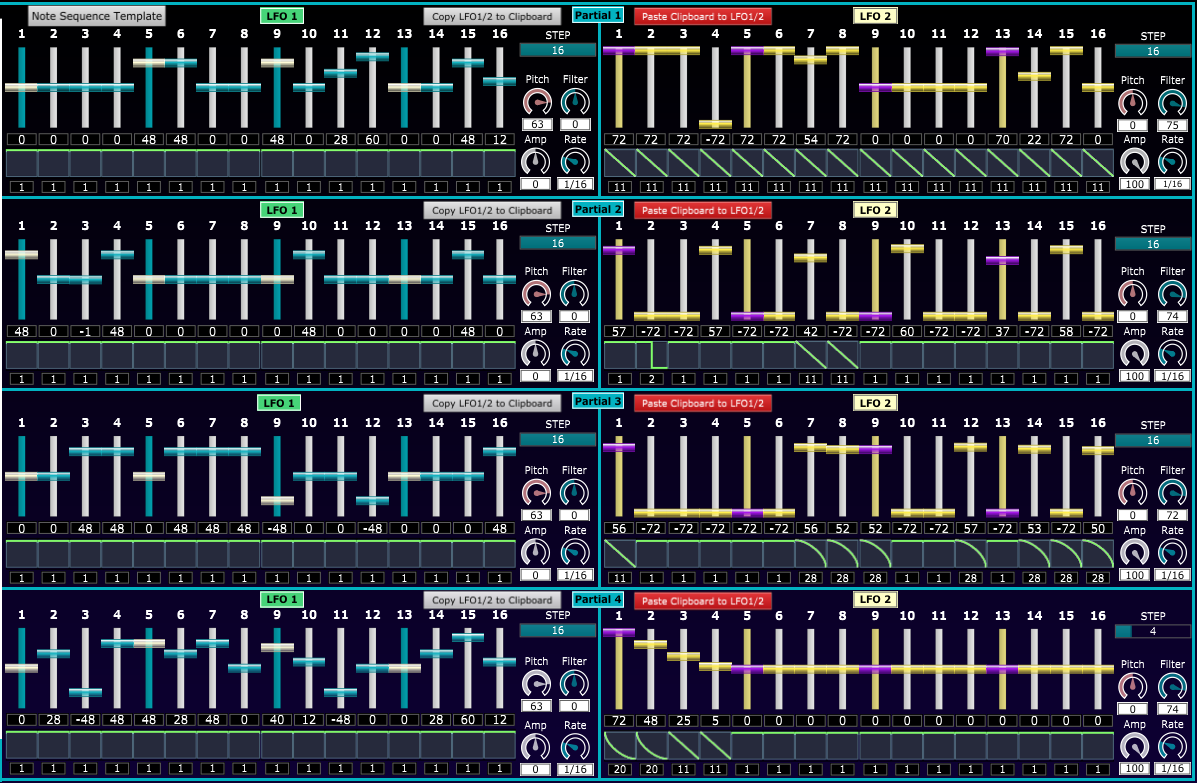
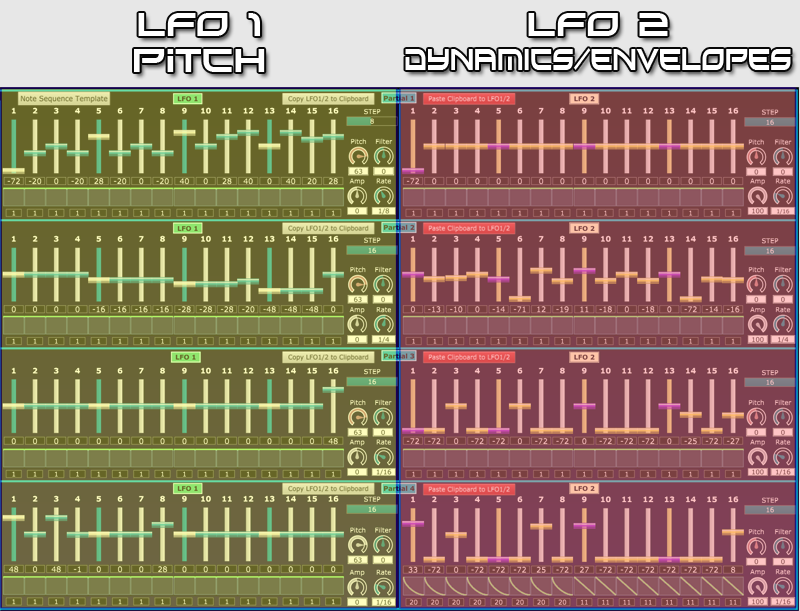
- 4-track step sequencer. Using a Template it is possible to
obtain 4-voice melodic and rhythmic sequences with a single Zen-Core tone,
synchronized with the scene BPM.
To do this, up to 8 STEP-LFOs (2 for each partial) and 128 steps in total are
used simultaneously, all organized in a graphic interface designed to facilitate
programming.
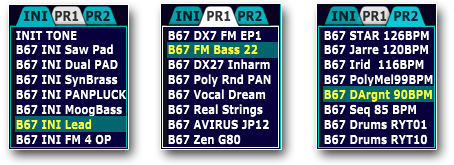
- 24 ZEN-Core presets, divided into:
INI: simple sounds to use as a template for editing. PR1: some of the most significant sounds from the optional
library that can be purchased separately PR2: ZEN-Core tones of rhythmic and melodic sequences (8
STEP LFO and related template)
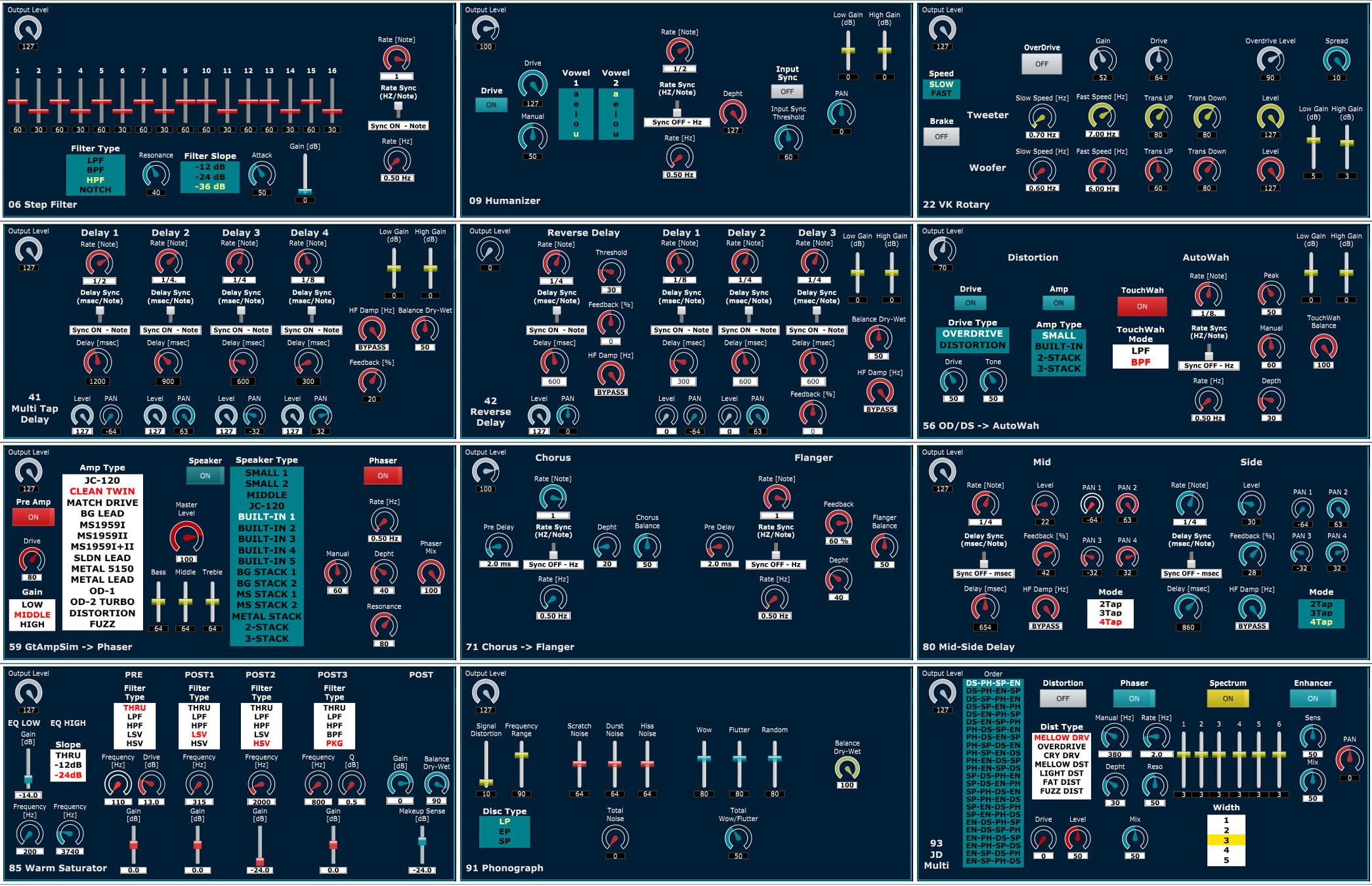
- Complete editing of the 93 effects of ZEN-Core standard and
25 presets for the most used effects
- import of ZEN-Core tones and conversion of sounds generated
with Model Expansions
All synths compatible with the ZEN-Core standard, the Roland
Zenology Pro software and the ZenBeat ZC1 player, are able to export the
ZEN-Core User Tones and, if available, the User Tones obtained to files (.SVZ
format) with the various Model Expansions.
Through a proprietary conversion algorithm it is possible to load and
convert the user Tones (*.svz files) into the format used by the
editor-librarian, so as to load the user sounds of your synths into the library
and possibly modify them via the editor. This is possible thanks to a series of proprietary conversion routines.
For equivalent Model Expansions User Tone→Tone ZEN-Core conversion, the USER
TONES of the following Model Expansions are supported: JUNO-106 -JX-8P
-JUPITER-8 -SH-101 - Juno-60 - JUNO-X engine - JUPITER-X/XM engine
IMPORTANT: *.SDZ sound banks (those that can be purchased via Roland Cloud
Manager) are NOT supported as they are encrypted and protected by license.
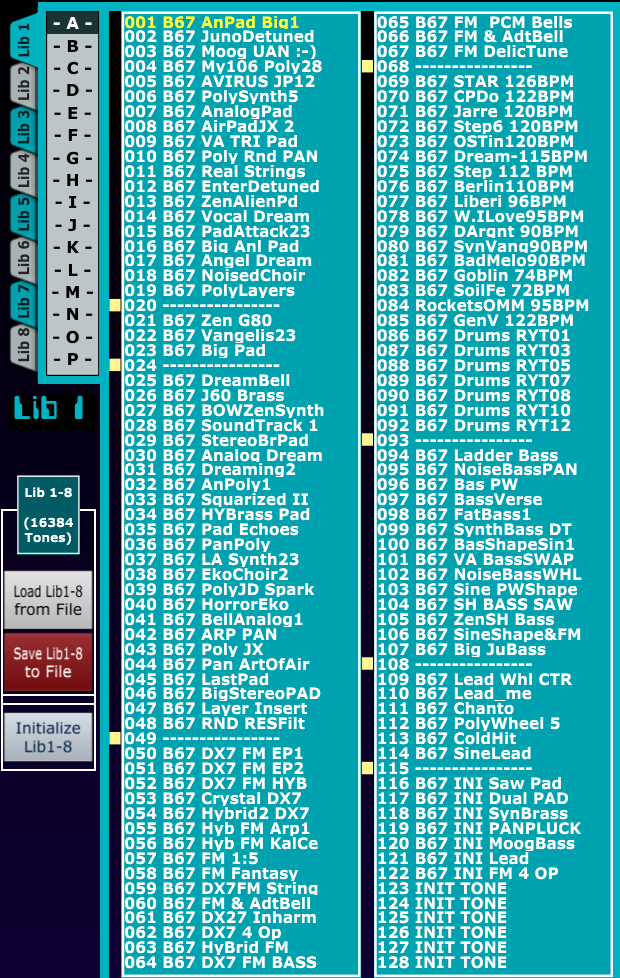
ZEN-Core Librarian Section
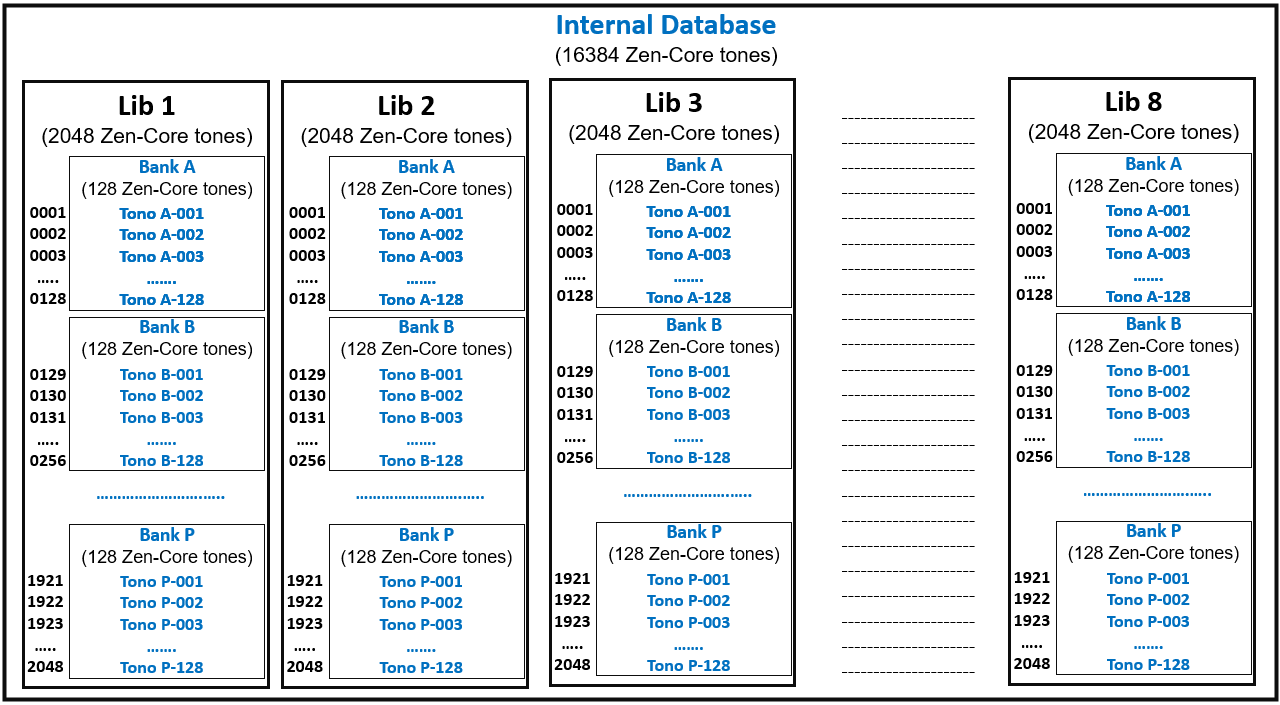
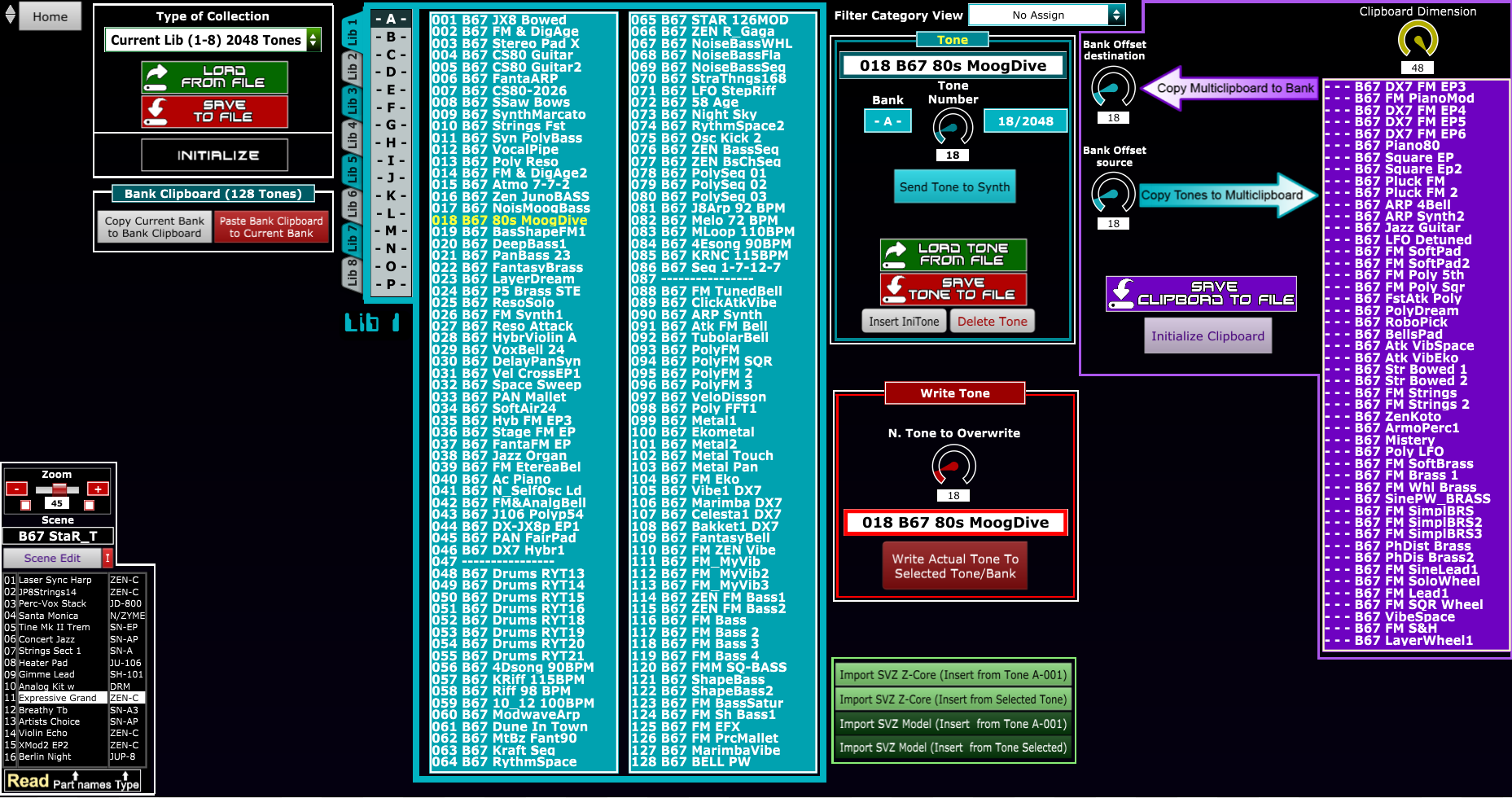
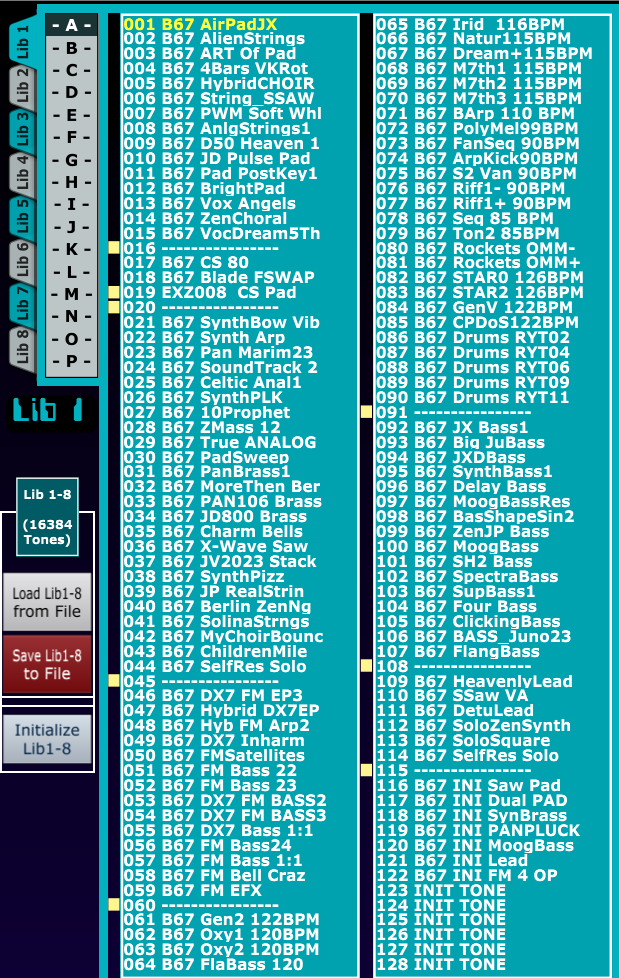
Management of 16384 ZEN-Core tones, all resident in memory, via a
database structured in 8 libraries (Lib1-Lib2,..Lib8) each composed of
2048 tones. Each of the 8 libraries is divided into 16 banks
(A-B-C .P) of 128 tones each.
The dialogue between Librarian and
Synth is in real time and it is possible to transfer
each tone to the synth in a fraction of a second
thanks to the speed of synth - computer
communication and the ability of the software to
quickly manage MIDI SysEx messages.
Possible operations:
- Load and Save to file the various
data structures: entire database (16384 Tones),
single library (2048 tones), single bank (128 Tones)
and single tone.
- Save in the library of the tones
transferred from the synth and possibly modified
with the editor.
- Insert e Delete tones
- Moving the individual banks (128
Tones) using a Bank Clipboard
- Copy and paste functionality of
tone groups, from/to the library, using a clipboard
of variable size (1-48 Tones).
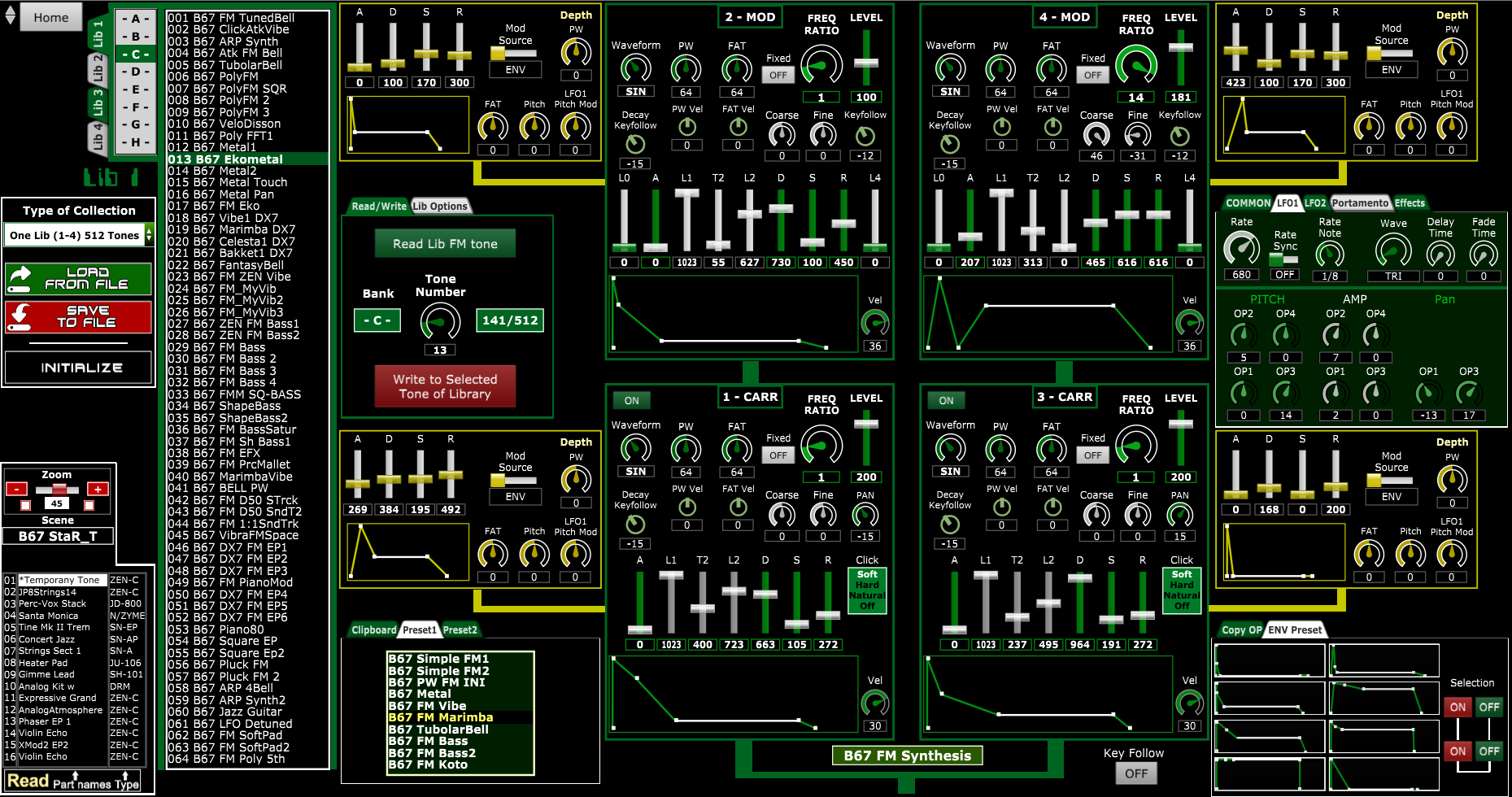
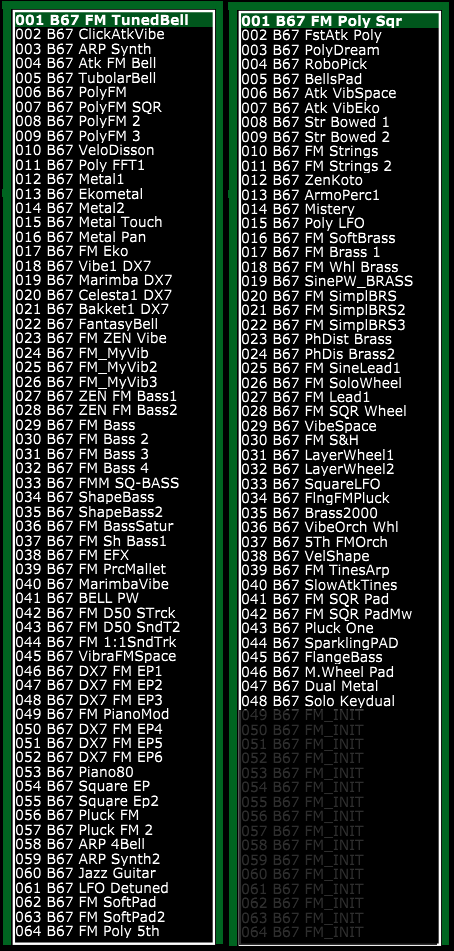
“B67 ZEN FM”
Engine (4 linear FM Operators + 4 Wave Shapes)
The "B67 ZEN FM" synthesis engine is fully implemented with
ZEN-Core synthesis, where a graphical editor allows you to modify only a
limited number of synthesis parameters, leaving the others predefined
and inaccessible.
The engine editor simplifies programming through an optimized
graphical interface that, among other features, implements the
ability to set operator frequencies with the Freq. Ratio
parameter (0.25, 0.5, 0.78, 1, 1.5, 1.57, 1.78, 2, 3, 3.5, 4, 5, etc.),
allows editing and viewing of the 8 ENVs in a single screen (2
carriers, 2 modulators, and 4 shapes), and implements convenient
copy and paste operations for ENVs and operators. Furthermore,
20
sound presets, ENV presets, and a dedicated librarian (2,048 sounds) are
always available.
Using the dedicated editor section, you obtain a standard
ZEN-Core tone that can be used on all compatible synths and virtual
instruments (Zenology Pro, Zenbeats (ZC-1), FP-E50, RD-88, RD-08,
Juno-D, Juno-X, V-Stage, MC-101, MC-707, Verselab MV-1, GM-800,
Aerophone AE-20 Pro AE-30, GO:KEYS 5, GO:KEYS 3). With the AX-Edge, Jupiter-X/Xm, and Fantom/0/EX editor you can not
only play the tones from this engine but also program them in the
dedicated editor section. Furthermore, the dedicated librarian allows
you to save and recall parameters for later editing.
Because the B67 ZEN FM engine uses the ZEN-Core standard, the sounds
created can be edited on synths like any other tone, thus freeing
oneself from the engine's fixed synthesis. Obviously, you lose the
immediacy of editing, access to the dedicated librarian, and the ability
to set the operator frequencies with the Freq. Ratio control.
The synthesis engine is stereo with 21-22 voices of polyphony (10-11 in
the MC-101/707 and MV-1 grooveboxes).
Implemented structure
Synthesis is implemented with a dual pair of
carrier/modulators (1-2 and 3-4). The two pairs have identical
characteristics: all parameters of pair 1-2 are the same as those of
pair 3-4. In classic FM synthesis, well known from historic synths such
as the Yamaha DX7, oscillators, called operators, produce sine waves: in
a carrier/modulator pair, the timbre is defined by the frequency ratio
of the operators and their volume, which is modulated by envelopes.
The
Frequency Ratio is defined as the ratio between the frequency of the
modulator and that of the carrier.
● If the ratio is an integer (e.g., C/M = 1:1, 1:2, 1:3), harmonic
sounds are obtained.
● If the ratio is a non-integer (e.g., C/M 1:1.78, 1:3.5, etc.),
inharmonic sounds are obtained (metals, membranes, bells, etc.).
The volume of the modulator, which varies over time with its envelope,
defines the amount of harmonics in the resulting timbre.
In the implementation of the B67 ZEN FM synthesis engine, each
carrier/modulator pair is capable of creating more complex sounds than
traditional Yamaha synthesis with sinusoidal operators.
Advanced Features: Waveform Shape
The FM of the first family of Yamaha synths (DX7,
DX5, DX21, etc.) used sinusoidal operators. Yamaha later implemented
more complex waveforms in its FM synths: from the classic 8 Waves of the
TX81Z to the 7 Waves of the Montage family, which feature additional
parameters capable of permanently modifying their harmonic content.
The B67 ZEN FM engine not only uses the 9 waveforms typical of the
ZEN-Core synthesis VA oscillators (SIN, SIN2, TRI, TRI2, TRI3, SAW, SQR,
RAMP, JUNO) but also implements the ability to dynamically modify
these waves.
Each waveform can be modified with the PW and FAT parameters not only
statically, but also dynamically thanks to the ability to modulate PW
and FAT with velocity and a dedicated ADSR envelope for each operator.
The 4 operators have the ability to edit: Waveform, PW, FAT, PW Velocity, FAT Velocity, dedicated ADSR envelope with separate PW and FAT depth.
These parameters can be used to modify the waveform in various ways. One
of the particularly useful possibilities comes from the PW functionality
applied to the sinusoidal waveform which distorts (64→127) the wave
until it becomes similar to a SAW. It is a process similar to the phase
distortion (PD) synthesis famous for the Casio synths of the CZ
family where the phase distortion is modulated inside the DCW
(Digital Controlled Wave) section.
By modulating the PW and FAT with the
Key Velocity, a
dedicated ADSR ENV, or the Mod Wheel, you can obtain sounds impossible
to achieve with pure FM and, in some cases, similar to PD synthesis.
The simplest way to use Waveform Shape of a
simple sine wave is modulate the PW by the dedicated ENV ADSR.
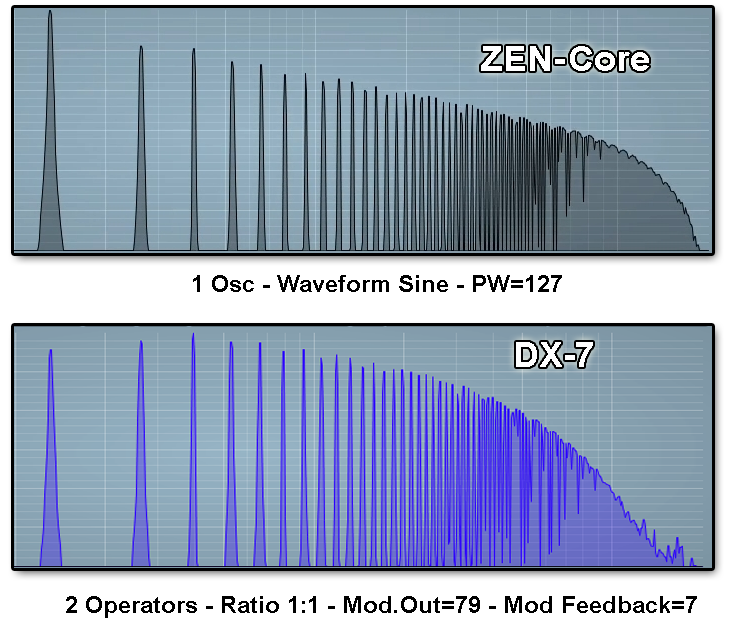
If we analyze the simple sinusoidal ZEN-core oscillator with PW=127 we
find a waveform very similar to the SAW.
A very similar waveform can be obtained using a DX7 using a
carrier-modulator pair, the same frequency (ratio 1:1), modulator
volume = 79 and feedback =7.
For this reason, the behavior of a sinusoidal
oscillator in the B67 ZEN FM engine with a PW modulated by a
dedicated ENV (64 → max 127) is very similar to that of a
modulating carrier pair with a 1:1 ratio where the modulating volume
varies with the same dedicated ENV.
The B67 ZEN FM engine, when using sinusoidal
oscillators and modulating the PW (Depth 0-63) with the 4 dedicated ADSR
ENVs can be considered similar to the following FM algorithm.
LFO1 and LFO2
The B67 ZEN FM engine features
two identical LFOs, whose speed can be synchronized with the tempo, 11
Waveforms, with Delay and Fade Time. The modulation amplitudes are
adjusted via: Pitch, Amp and Pan Depth.
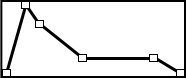
Copy Operators - Copy Partials
In the editor it is possible to
past and copy the 4-step envelopes
of
the 4 operators (Carrier 1-3 or Modulator 2-4) or the entire set of
parameters (Waveform, Frequency, ENV 4 Step, ENV ADSR, etc.).
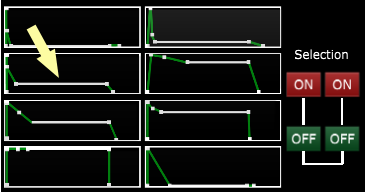
4 STEP ENV Preset
There are 8 ENV presets available for the 4 operators (carriers and/or
modulators), containing predefined profiles (Percussion, Brass, Slow
Decay, Organ, etc.).
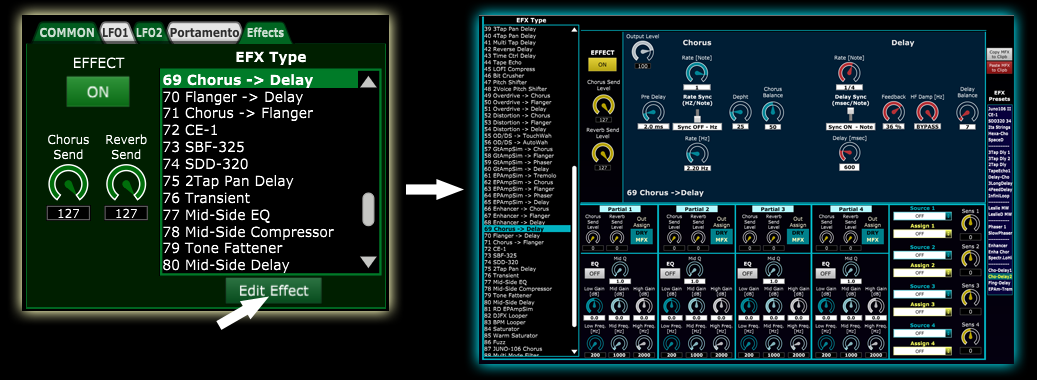
MFX Effects
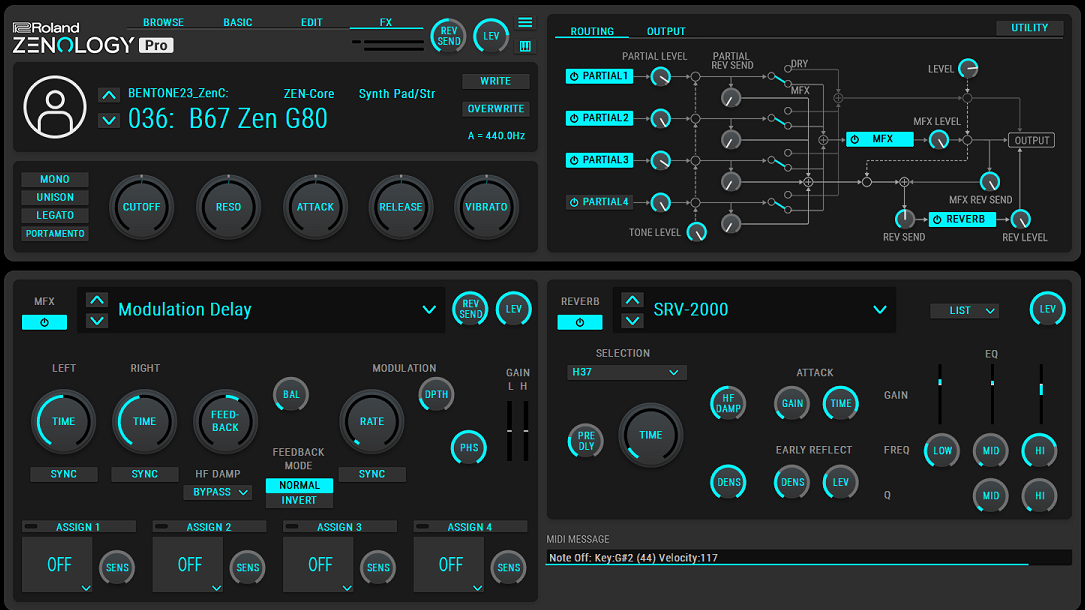
The B67 ZEN FM engine uses the 93 MFX effects of the ZEN-Core standard:
you can select the effect type and edit it in the dedicated section (the
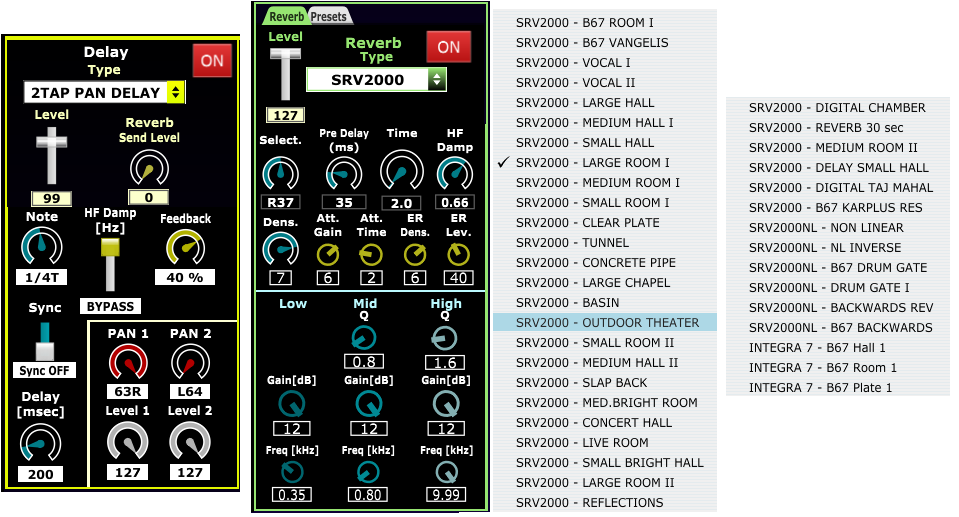
same as the ZEN-Core editor), which also contains 25 MFX presets.
Scene Editor Section
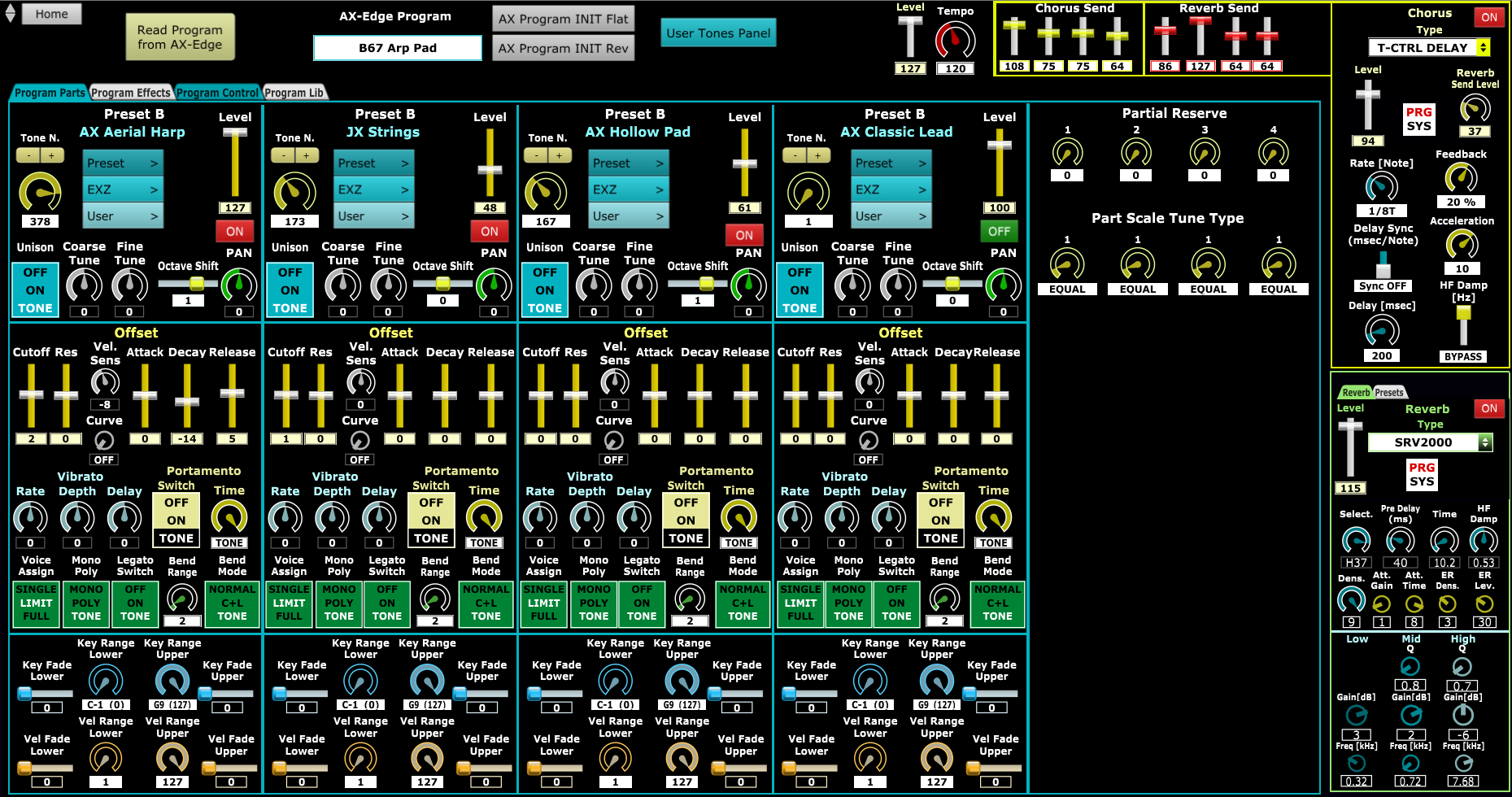
Within this section, in the version of the software for AX-Edge and
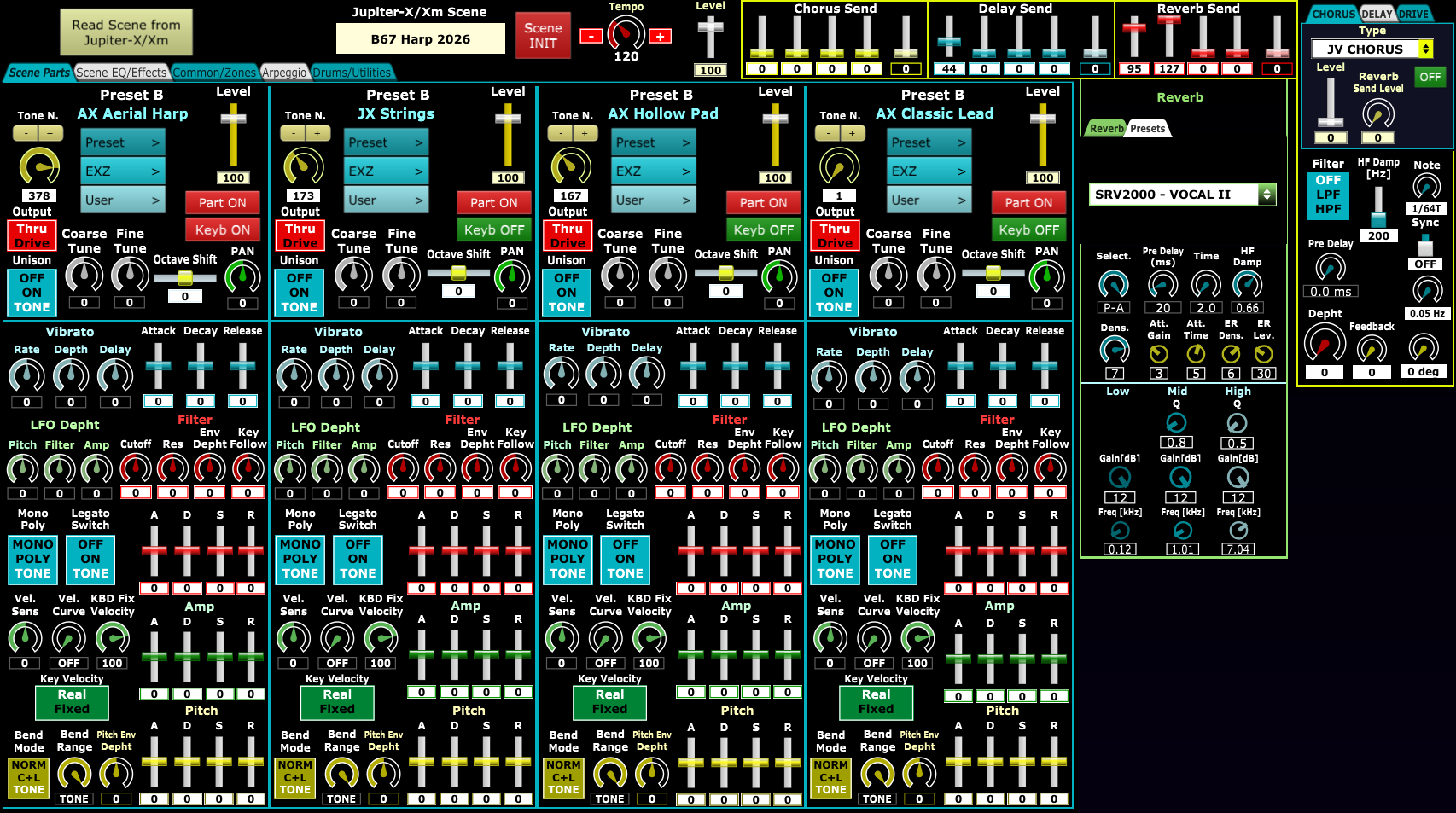
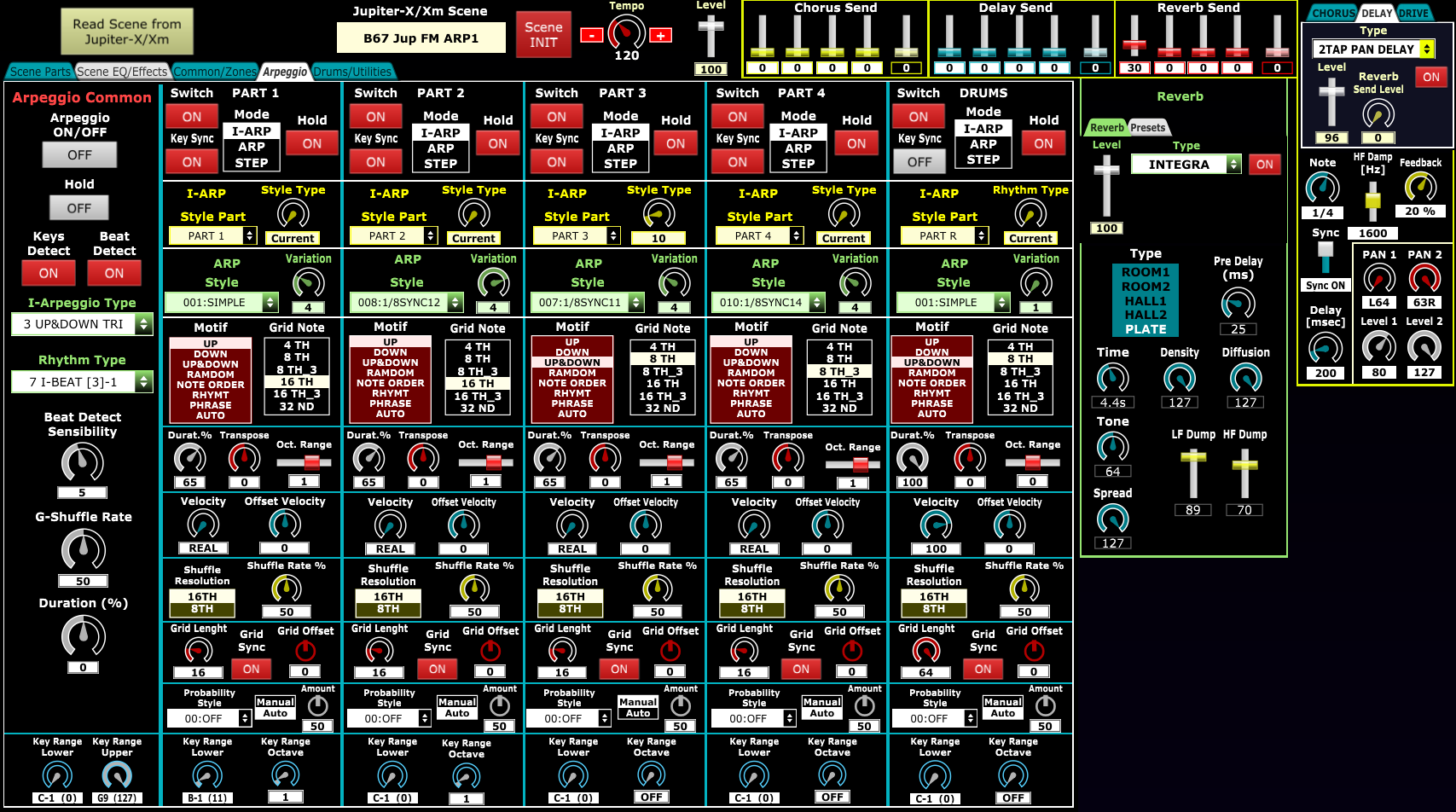
Jupiter-X/Xm, all parameters of the scene (performance in AX-Edge) can be
edited with a graphic interface (Volume, Pan, sound selection, synthesis
parameter offset, keyboard range and speed..) along with all the parameters
relating to the scene effects (Reverb, Chorus, Delay,..).
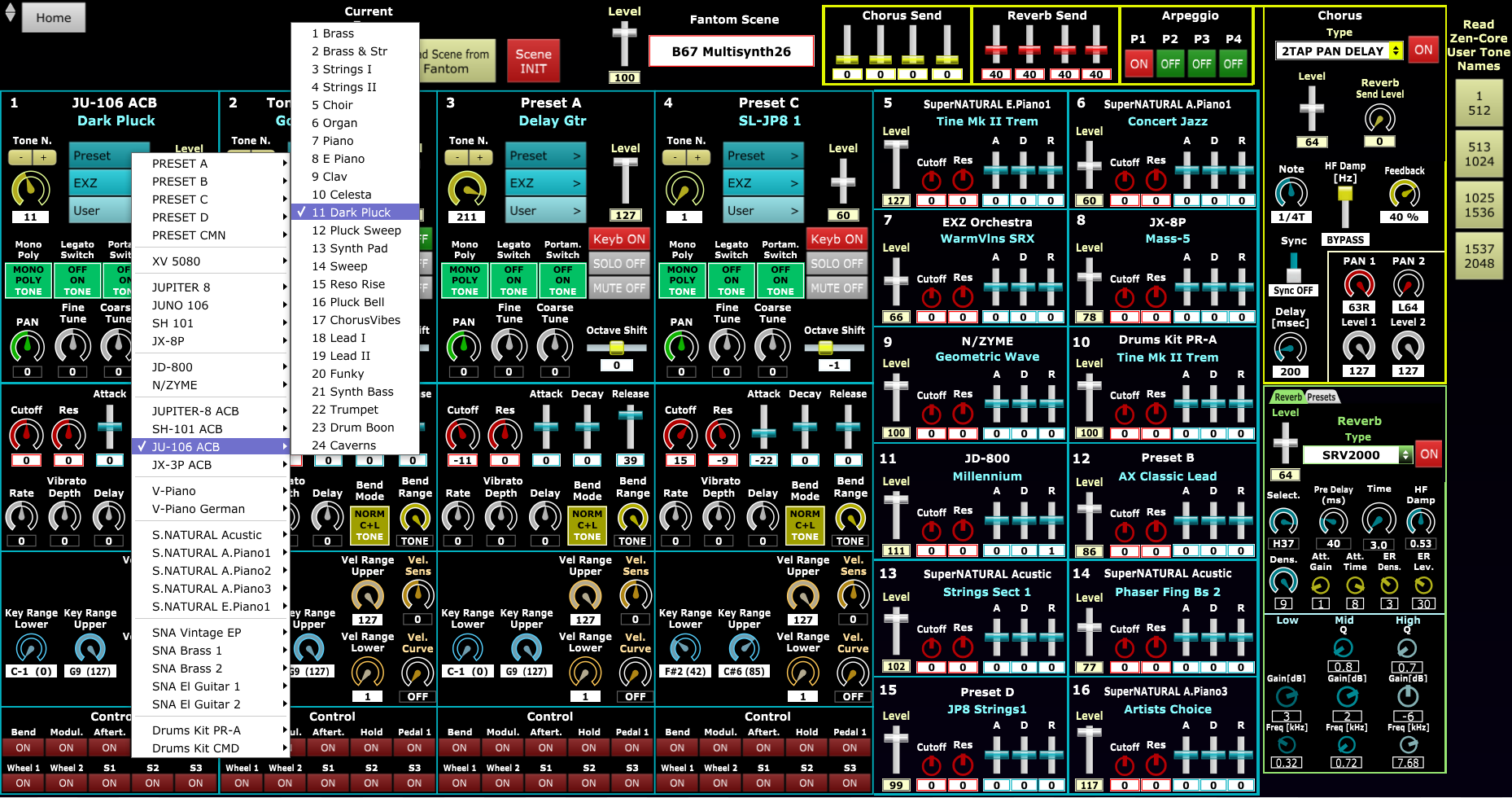
The Fantom version of the software contains complete editing of the scene
effects and editing of the main parameters of parts 1-4.
There are also 40 preset reverb effects.
Jupiter-X/Xm Scene Editor
Fantom Scene Editor
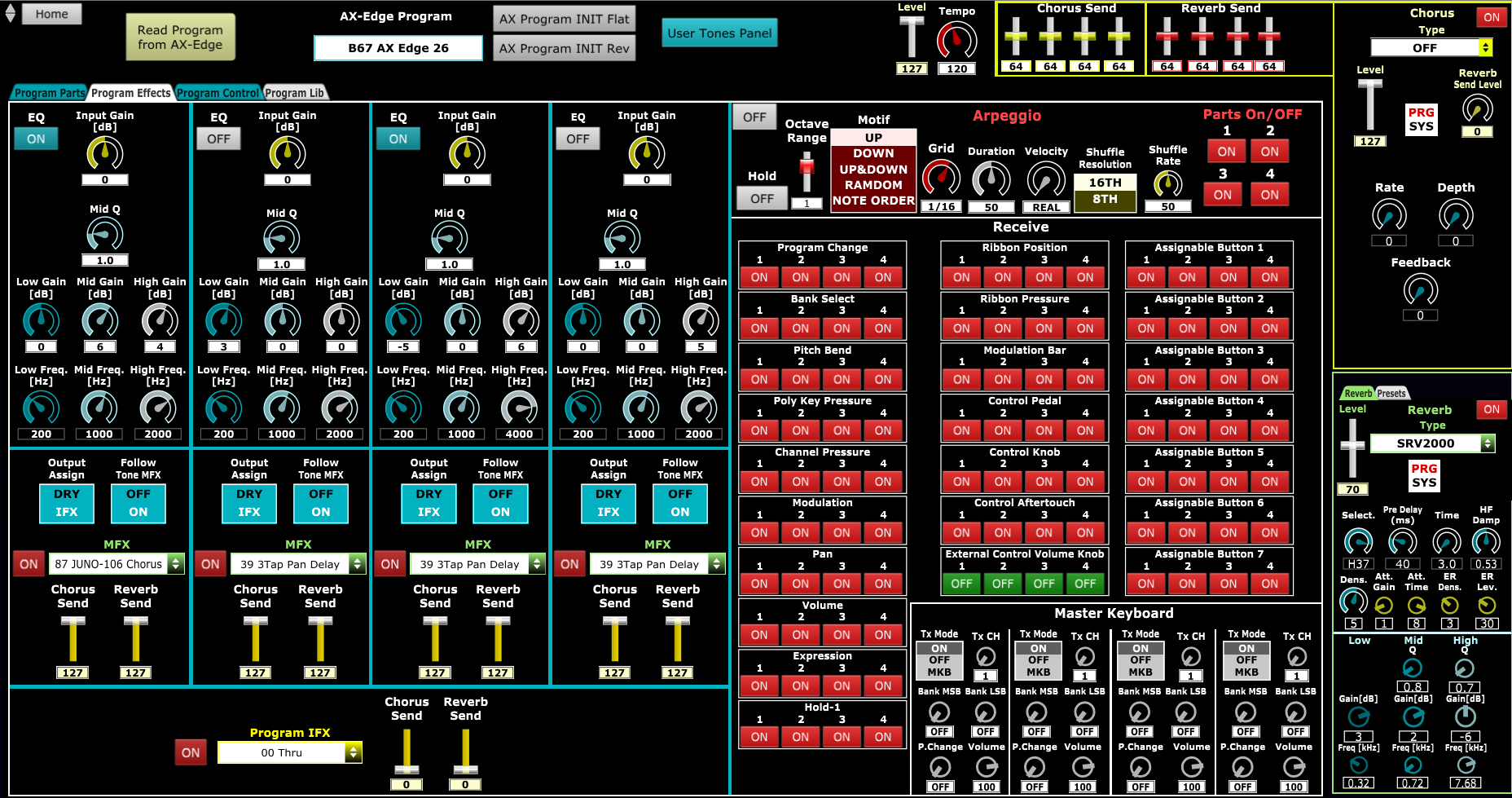
AX-Edge Program Editor
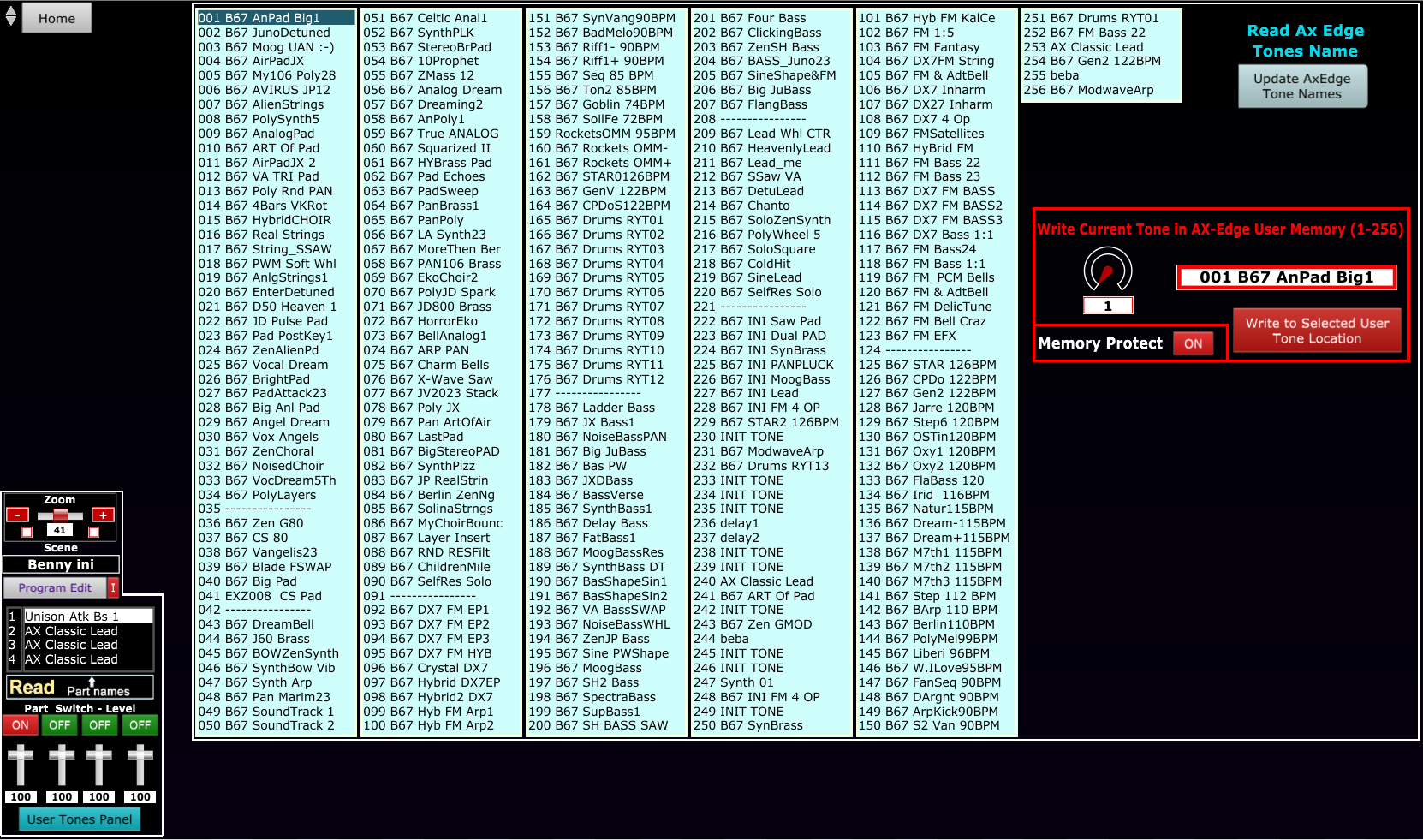
User Tone section and Program librarian for AX-Edge
Through a dedicated section, available only in the AX-Edge
version of the software, it is possible to store, directly on the "User Tones"
memory of the synth, the tones modified with the editor or loaded from the
library.
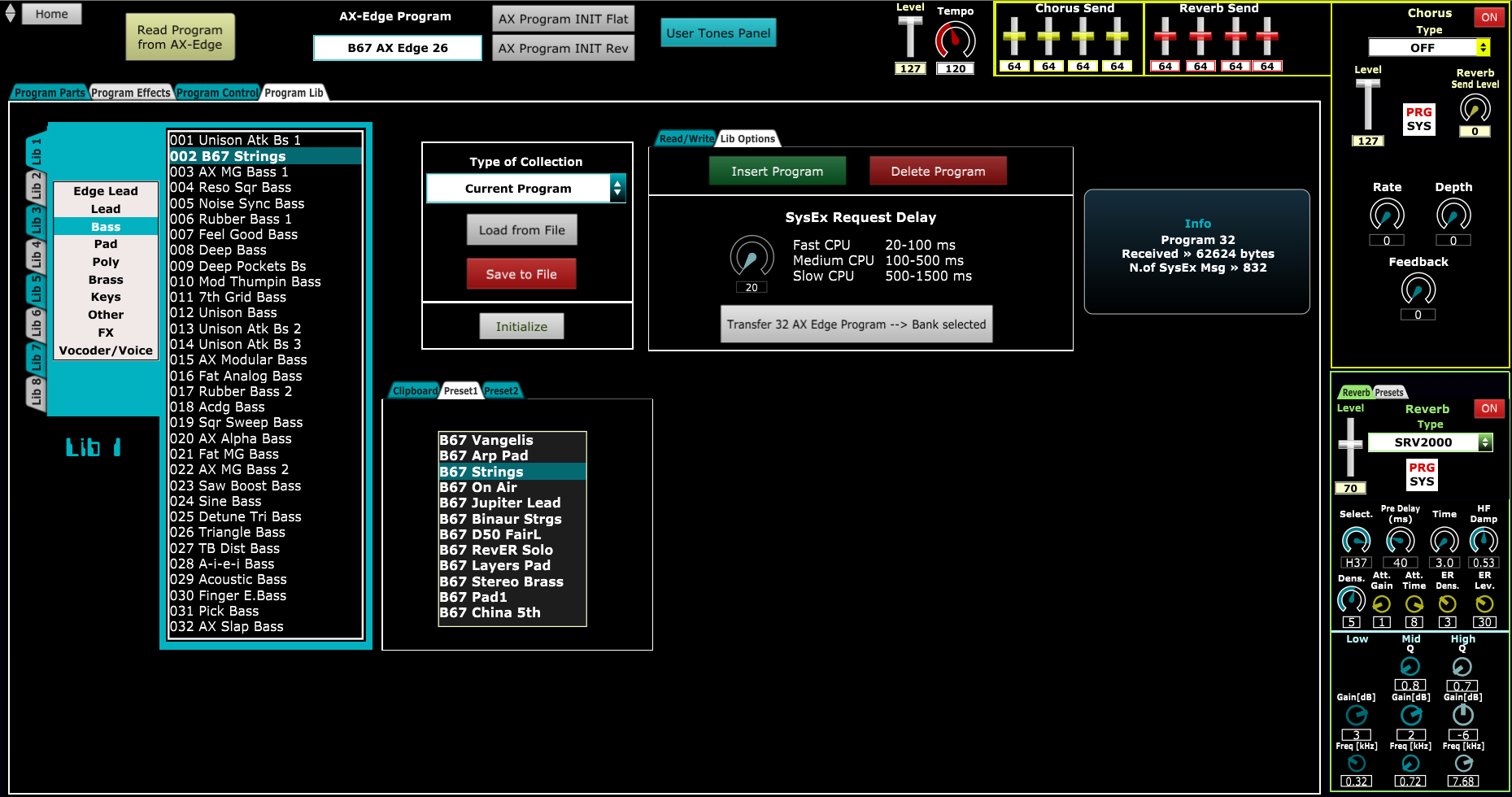
Version 2.0 of the editor includes a Program Librarian organized into 8
Libraries x 320 program per library. You can import Synth programs and use the clipboard to
manage them.
Changelog Version 2.0
● ZEN-Core editing on any part (1-16 Fantom / 1-4 Jupiter-X/Xm and
AX-Edge): removed the editing limit on part 1.
● New B67 ZEN FM synthesis engine (4 FM Operators + 4 Wave Shapes)
compatible with the ZEN-Core standard with editing, 20 presets,
dedicated librarian (2048 tones for the B67 ZEN FM engine divided into 4
LIBs / 8 Banks of 64 tones) and the ability to load and save individual
tones, Banks (64 tones), Lib (512 tones), and All Lib (2048 tones) to
files.
● The librarian allows you to reload and edit a sound with the B67 ZEN
FM engine, having access to all its parameters in the graphical
interface of the engine editor.
● 40 preset reverb effects (Scene/Program).
● AX-Edge Editor Only
○ Full editing of Program parameters (added 24 Receive, Master Keyboard,
Assignable Button, Assignable Control, Partial Reserve, Part Scale Tune Type)
○ 25 Program Presets
○ Program Librarian with the ability to load and save individual Programs, Bank
(32 Performances) Lib (320
Performances), All Lib (2048 Tones) to files
○ AX-Edge→Librarian transfer of Programs
● Fantom Editor Only:
○ Fantom EX presets added: Jupiter-8 ACB, SH-101 ACB, JU-106 ACB, JX-3P
ACB, SNA Vintage EP, SNA Brass1, SNA Brass2, SNA El guitar 1, SNA El
guitar 2, Supernatural A.Piano3 e Supernatural E.Piano1
○ Levels, Cutoff, Res, Attack, Decay, and Release offsets added to parts
5-16.
● Bugfix
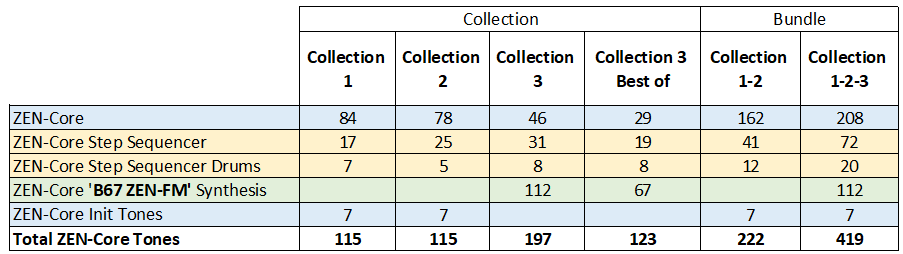
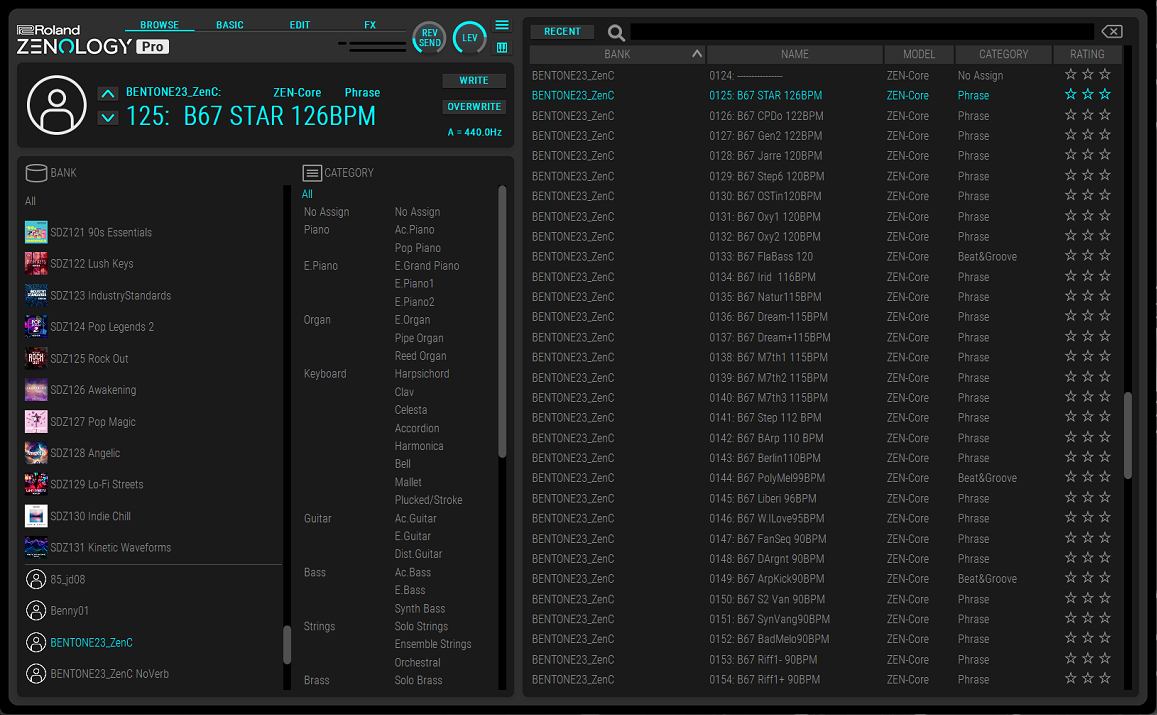
ZEN-Core Sound Banks: 3 Collections
ZEN-Core Sound
Banks (419 tones) for all Roland Synthesizers, Piano,
Groovebox, Wind-Instruments, Guitar Synth
compatible with the ZEN-Core standard
It includes 112
tones created with 'B67 ZEN-FM'
synthesis. The sounds are distribuited
in two formats:
- Standard ZEN-Core format:
compatible with all synthesizers
- Proprietary editable format:
manageable via the dedicated B67 ZEN-FM
page in Editor/Librarian V. 2.0
Compatibility
Banks collection in .SVZ format loadable on all Roland software
and synths compatible with the ZEN-Core standard.
The bank also includes the version
(*.bin) with the reverb parameters programmed
specifically for each sound: this bank can only be
used with the Zenology software starting from version 2.0.
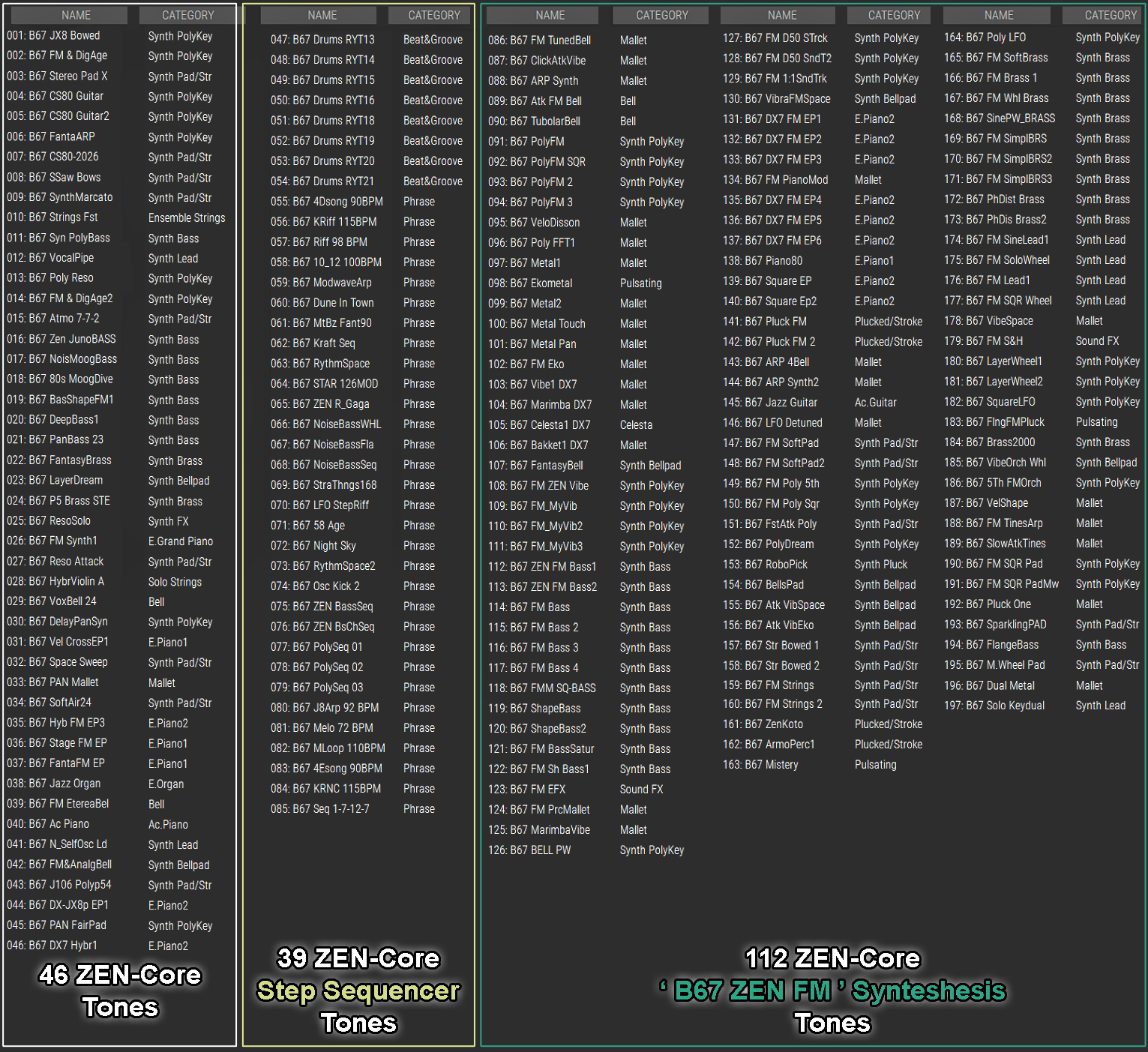
The B67 ZEN-Core Collection 3
(197 ZEN-Core tones) includes 112 tones created with
B67 ZEN-FM synthesis (4 FM operators + 4 Wave
Shapes).
These sounds are distribuited in two formats:
- Standard ZEN-Core format: compatible with all synthesizers, keyboards, and grooveboxes that support this standard.
- Proprietary editable format: manageable with the dedicated B67 ZEN-FM page in Editor/Librarian V2.0,
available for Fantom, AX-Edge, and Jupiter-X/Xm.
Characteristics
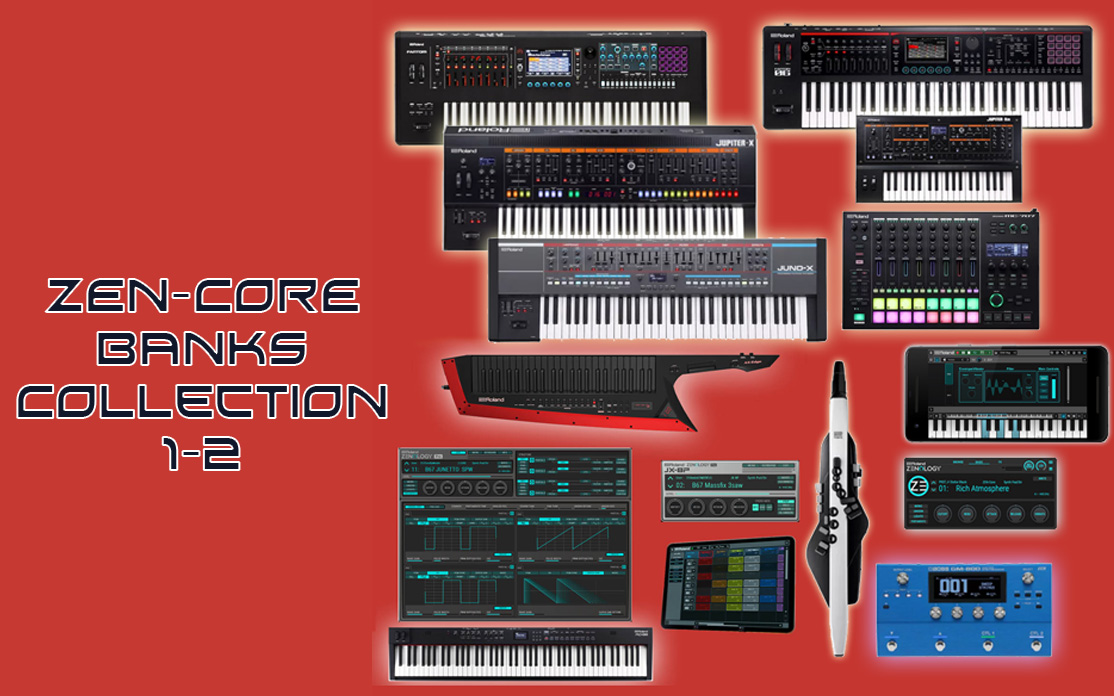
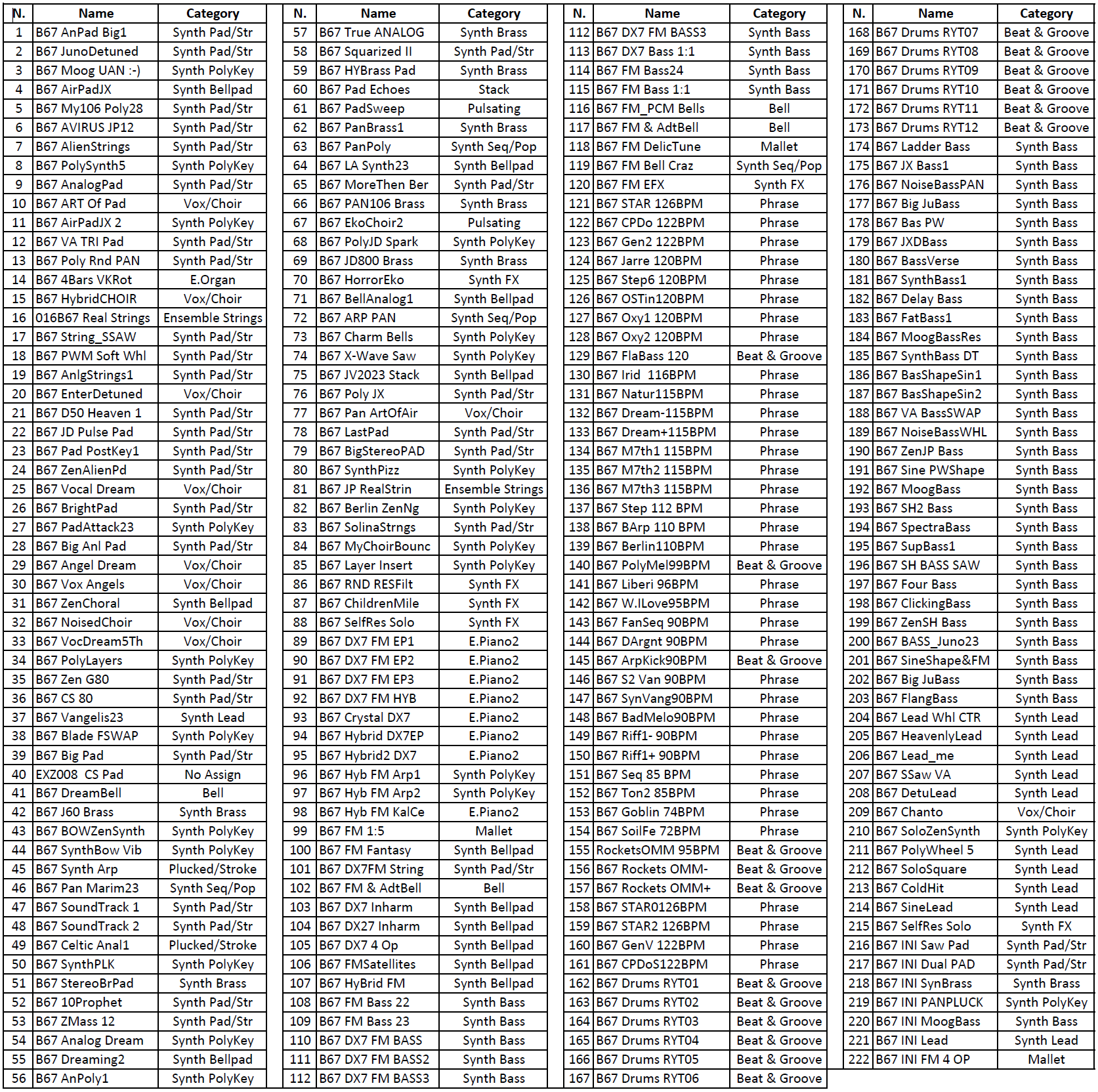
B67 ZEN-Core Collection 1-2
The collection includes, among the various sounds:
- 41 ZEN-Core tones containing 4-voice melodic and rhythmic sequences,
synchronized with the scene BPM. Thanks to the simultaneous use of 8 STEP-LFOs
(2 per partial) and 128 overall steps
- 12 ZEN-Core drum patterns with ZEN-Core 8 STEP-LFOs
- 32 linear FM tones, some created with 4 operators (double carrier-modulating
pair) and some composed of a pair of FM partials and partial PCM
-30 Bass Synth tones
- more then 50 Pad, PolySynth, Lead and Choir tones
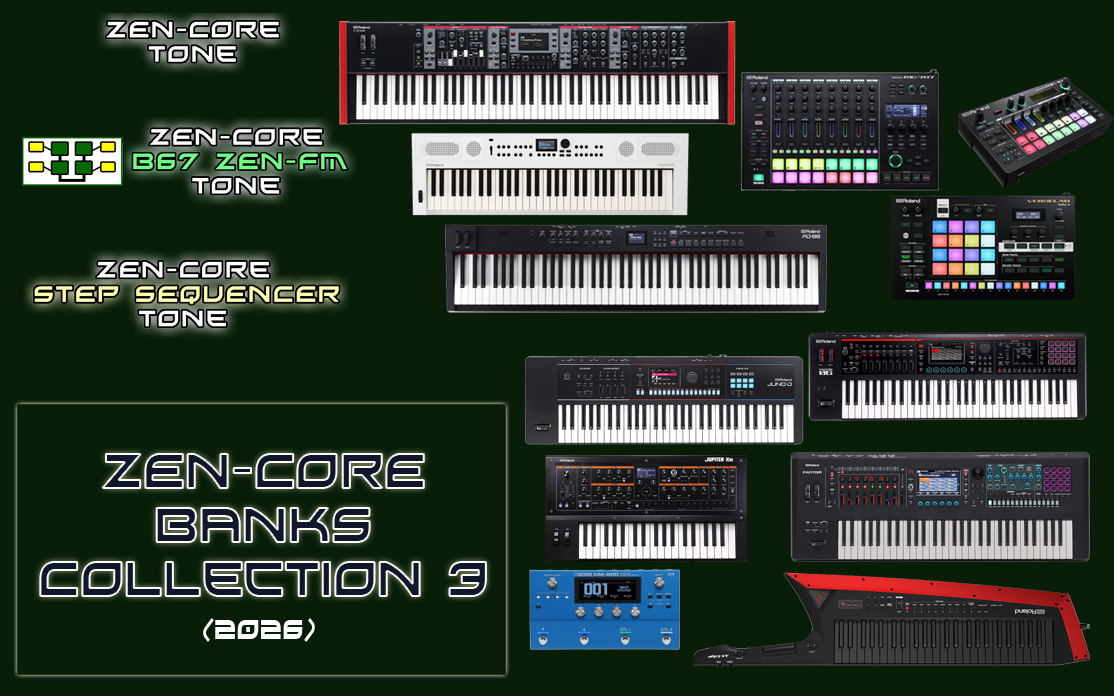
B67 ZEN-Core Collection 3
The collection includes, among the various sounds:
- 31 ZEN-Core tones containing 4-voice melodic and rhythmic sequences,
synchronized with the scene BPM. Thanks to the simultaneous use of 8 STEP-LFOs
(2 per partial) and 128 overall steps
- 8 ZEN-Core drum patterns with ZEN-Core 8 STEP-LFOs
- 112 tones created with
B67
ZEN-FM synthesis (4 FM operators + 4 Wave Shapes).
Among the various sounds created with this synthesis are emulations of "classic
Yamaha DX7" sounds (Marimba, Vibe, Celesta, Bakket, Jazz Guitar, Tubular Bell, EPiano,
Bowed Strings, Brass, Synth Bass, Metal..) and original sounds that use FM and
Wave Shape synthesis for new sounds with complex and evolving harmonic spectra.
-46 complex ZEN-Core tones including natural sounds (Fast Strings,
Acoustic Piano, etc.), synthetic sounds (80 MoogDive, CS80 Guitar, JX8 Bowed,
JunoBass, etc.), and hybrid sounds (HybrViolin, FM&DigitAge, VocalPipe, etc.)
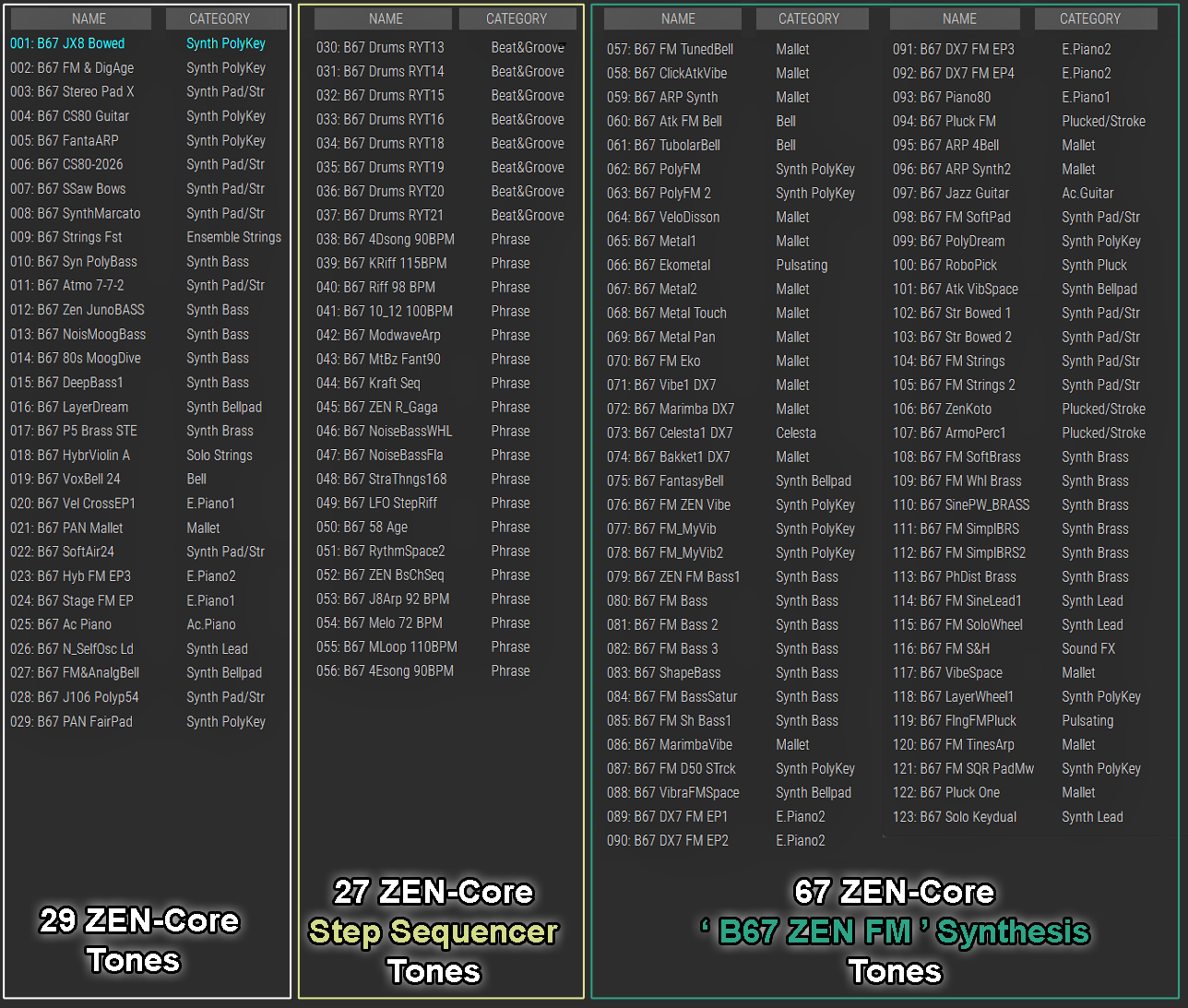
The ZEN-Core collection 3 is also available in a "Best Of" version.









 of
the 4 operators (Carrier 1-3 or Modulator 2-4) or the entire set of
parameters (Waveform, Frequency, ENV 4 Step, ENV ADSR, etc.).
of
the 4 operators (Carrier 1-3 or Modulator 2-4) or the entire set of
parameters (Waveform, Frequency, ENV 4 Step, ENV ADSR, etc.).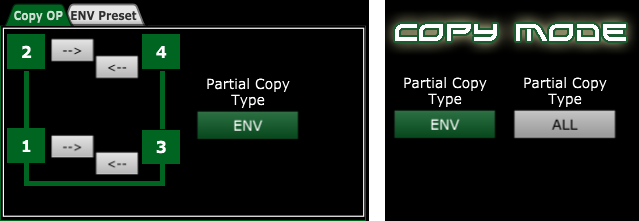



 Manuals